Copenhagen in 3 days: the itinerary I’d do again after two trips
Copenhagen in 3 days: two trips, one itinerary
The first time I went to Copenhagen I went on my own, it was November and the Christmas decorations were already up around town. I was working in an office and had just a few free days, which for me means only one thing: opening Google Flights and setting the destination to “everywhere”, and so a few weeks later I was on a plane from Bologna to Denmark. I’d got curious reading that it had been voted the safest city in the world, and I gave it 3 full days including a little day trip to the Deer Park, north of the city.
I then went back in August 2026, this time with Fabio! In Italy it was 39 degrees and we escaped towards the 23 degrees of Copenhagen, with the goal of eating lots of cardamom buns and cinnamon rolls. Mission accomplished. 🙂
What you’ll find below isn’t the diary of one of the two trips, but the itinerary I built by putting both together. The stops I’d do again exactly the same, the ones I only discovered the second time and had missed the first, and the ones I cut because, honestly, they’re not worth the time they take up.
Where to stay in Copenhagen
Let’s be clear right away, friends: Copenhagen is really expensive and you need to factor that in from the very start. Accommodation, as we well know, is almost always the heaviest item of a trip. The first time I set off with a backpack (if you’re after a perfect backpack for a weekend I always recommend my beloved Ecohub, which you’ll find on Amazon by clicking HERE, and which slips through for free as a “handbag”) and with no cabin baggage, precisely to start saving from the off.
My choice travelling solo
The first time I slept at the CABINN Copenhagen (you’ll find it HERE on Booking), and here I have to be honest because these days the reviews aren’t thrilling. The room was tiny and the bathroom even smaller. I was on my own, I had a backpack and I only went back to the room to sleep. For me it was absolutely fine!If you’re a couple I’d advise against it unless you go for the more expensive, and therefore larger, rooms. It’s a huge property, basic, no-frills. We’re in the Vesterbro area, next to the Fisketorvet shopping centre, about 1.2 km from the Central Station and from Tivoli, so around fifteen minutes on foot.
It makes sense if: you’re travelling alone or at least light, for a few nights, on a tight budget, and you only need the room to sleep in.
Our choice as a couple: the apartment
In August 2026 we chose an apartment because I remembered well how much it costs to eat out in Copenhagen, and for two people the difference between three restaurant meals a day and a supermarket shop is enormous. We booked at Numa Copenhagen (which you’ll find HERE on Booking) and had a great time: a spacious, modern apartment, a full kitchen, all new and clean. There is a reason it costs much less than the city average, though: it’s not central. We’re in the Nordvest area, a 7-minute walk from Nørrebro station, the red metro (the M3 line, the ring that circles the city). From there the centre is at most 10 minutes by metro. For us it worked out perfectly, but if you’re after the kind of hotel you step out of and you’re already in Nyhavn, this isn’t it.
The other options we considered
These two I didn’t try, so I’m flagging them as alternatives I’d researched for our dates.
Locke Copenhagen (you’ll find it by clicking HERE on Booking) — It was our second choice and it’s much more central: practically attached to the Central Station, a block from Tivoli, with apartments fitted with a kitchen and washing machine. Excellent reviews and, for our dates, a good price.
Comfort Hotel Vesterbro — about 5 minutes from Vesterport station and under 10 minutes on foot from Tivoli and the Central Station. Simple, not large rooms, but soundproofed and clean, all much appreciated in the reviews.
If you want to stay in the centre
So far I’ve told you about places chosen with saving in mind, so all outside the centre. If your priority is stepping out of the hotel and finding yourself already in the city (and you have a higher budget) I’d recommend taking a look at Babette Guldsmeden (you’ll find it by clicking HERE). We’re a few minutes on foot from the Marmorkirken, the Little Mermaid and Nyhavn. It’s a hotel belonging to the Danish chain Guldsmeden: four-poster beds, an eco and organic ethos and a rooftop terrace with a sauna and a view of the Marmorkirken. Things to know before booking: the rooms are small and the rooms on the street side can be noisy, so it’s worth asking for a room on the inner courtyard; also, breakfast isn’t cheap. Although in a city like Copenhagen it’s a shame to have breakfast in the hotel with all the incredible bakeries there are! Put plainly: it’s the most expensive option on this list, I’m flagging it because if the purpose of the trip is to stay in the centre, that’s more or less the price in Copenhagen.
Staying in Copenhagen on your own: is it safe?
Copenhagen is consistently near the top of the rankings of the safest cities in the world, and it’s a feeling you sense as you walk down the street. I’m telling you this as a woman who was there alone: I’d taken a hotel in the station area, I always came back late and in the dark, and I never once felt uneasy.
Getting around Copenhagen
Copenhagen is compact and very walkable, but the metro is super handy and also connects the airport to the centre in about fifteen minutes. You have two options.
The Copenhagen Card. If you’re planning to go into several attractions, it’s almost always worth it: it includes entry to over 80 attractions and unlimited public transport. I’d bought it the first time because I knew I had to go into several museums, and between entries, buses and trains I saved money. You’ll find it by clicking HERE, and with the code ANGELAISAI5 you pay even less. The advice is always the same: do a quick sum of what you’d spend on the museums you genuinely care about, and work out whether it’s worth it.
The Rejsekort app. If, on the other hand, you’re not interested in museums, download this: it activates as soon as you board and deactivates when you get off, and the system works out the correct fare by itself. Careful, this is the most important thing: on the metro there are no barriers and nobody stops you at the entrance, but checks are very frequent and the fine for travelling without a valid ticket is 750 kroner, that is about 100 euros. Always remember to check in and check out.
One last useful note: in Denmark they don’t use the euro, all prices are in Danish kroner and euros aren’t accepted. On the plus side you’ll never need cash, because you pay for everything by card, even a coffee or a small bottle of water.
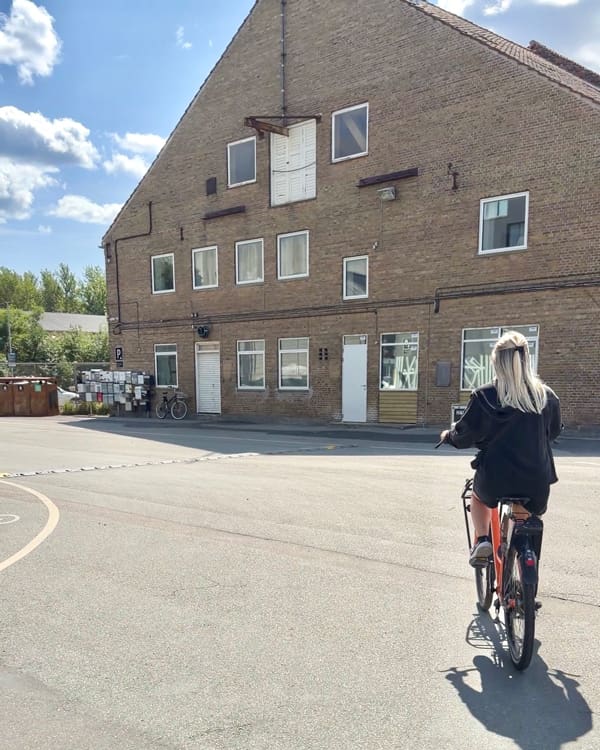
Another alternative we really liked: the bike! You can unlock them with your phone by downloading the app you'll be pointed to, and they cost very little.
Day 1 — From the fortress to the royal quarter
The first day I’d build entirely along the water, coming down from north towards the centre: it’s a linear route, you never double back, and you walk with the harbour beside you the whole time.
Morning: Kastellet and the Little Mermaid
You start from Kastellet, a star-shaped military fortress still perfectly preserved, with a windmill and the canals that surround it. Entry is free and it’s one of the most beautiful spots in the city in any season.
On the way out, along the waterfront, there’s the Little Mermaid. I’ll tell you honestly: it’s tiny, it sits on a rock a few metres from the shore and there’s always a queue of people around it trying to photograph it without the other people. We saw it, we moved on. A little further on, inside the park, there’s St Alban’s Church, the only Anglican church in Denmark, which in my opinion is far more photogenic than the statue.
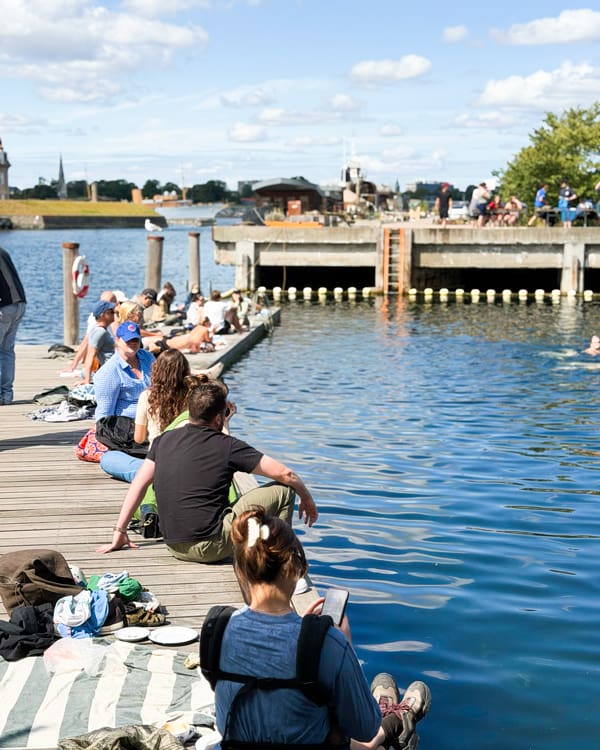
If you’re travelling in summer and want to extend: about twenty minutes on foot to the north there’s Nordhavn, the district built on the former industrial port. It’s not an unmissable stop and in low season I’d skip it, but in summer you’ll find Sandkaj, the swimming area right in the harbour where the Danes dive in among the quays. Around it there are several bars and bakeries.
Lunch: Broens Gadekøkken
Coming down towards the centre you reach Broens Gadekøkken, a street food market on the bridge right opposite Nyhavn, with tables looking out over the water. I recommend it because the restaurants on the Nyhavn canal are among the most expensive in the city and not the best: here you eat well at half the price and with the same view.
Kastellet
The Little Mermaid
At Broens Gadekøkken you'll also find Gasoline, named in the past as the best cheeseburger in the world
Afternoon: the royal quarter
After lunch you head back up towards the area of the palaces: three stops a few minutes from one another.
Amalienborg is the residence of the Danish royal family: four identical palaces arranged around an octagonal square, with the statue of Frederik V at its centre, who was the palace’s true founder.
Here every guide will tell you to come for the changing of the guard, which takes place every day at 12:00 and is free. I’m flagging it but without any hype: it’s one of those moments where the crowd is such that you see little or nothing and a lot of people go home disappointed.
Two minutes on foot there’s the Marmorkirken, the Marble Church, with one of the largest domes in Europe: you can see it perfectly even just from outside.
Late afternoon: Nyhavn
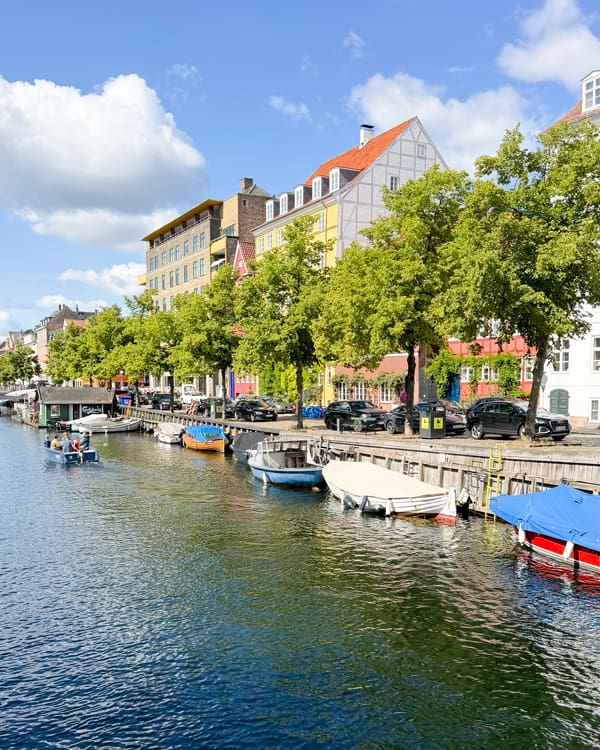
You round off with Nyhavn, the old port and the city’s official postcard: the colourful houses, the wooden boats, the bars along the canal. Two curiosities that make the walk more interesting: the house at number 9 is the oldest and dates back to 1681, while at number 67 Hans Christian Andersen lived between 1845 and 1864, where today you’ll find a commemorative plaque.
Where to have dinner on the first day
Copenhagen has one of the most famous food scenes in the world and that also means that the most celebrated restaurants have prices beyond the reach of a normal trip. We still wanted to try local cooking done well, and we used a method I’d recommend you copy: instead of looking at the Michelin-starred restaurants, we searched among theBib Gourmands, the Michelin guide category that rewards places with excellent food at a reasonable price. In Copenhagen there are quite a few, and it’s the easiest way to eat well without spending absurd amounts.
Our choice fell on Petra Bar Restaurant, which received the Bib Gourmand in 2026. It’s inside a 1943 building by the Danish architect Kay Fisker: original terrazzo floors and all the furnishings by one of the best-known Danish design brands.
We had a great time and I recommend it. Between the two of us we ordered two opening snacks, two starters and two fish mains, plus two bottles of sparkling water, and the bill was 1,060 Danish kroner, that is about 142 euros. Bear in mind we didn’t have wine: if you add it, factor in quite a bit more.
Marmokirken
Nyhavn
The main course at Petra Bar Restaurant
Day 2 — The old town and Vesterbro
On the second day you move inland: first the old town, then the district that in my opinion best tells the story of how Copenhagen has changed.
Morning: Indre By, the old town
You start from Strøget, one of the longest pedestrian areas in Europe: just over a kilometre of shops that crosses the whole centre as far as Kongens Nytorv, the city’s largest square, which in winter is home to a giant ice rink. Along the street you’ll also find Illum, one of Scandinavia’s historic department stores.
A few steps away, on a little island in the canal, there’s Christiansborg Palace, which houses the Danish Parliament.
Next to it, on the water, there’s the Royal Library, which everyone calls the Black Diamond: eight floors of black granite and smoked glass, with a cleft looking out over the harbour. Even just the façade is worth the detour.
Lunch: Torvehallerne
Torvehallerne is the covered market near Nørreport station: two glass pavilions with stalls of fish, cheese, bread, smørrebrød and kitchens of every kind. It’s the right place to eat alongside the locals without spending restaurant prices.
Afternoon: Vesterbro
Vesterbro has a history worth knowing before you walk through it: it was the working-class district and for years the city’s red-light area, considered the most run-down in Copenhagen. Today it’s one of the liveliest spots, but you can still see that soul in the vintage shops and the street art covering the walls.
A little further on there’s Frederiksberg park, huge and crossed by canals. Like all of Copenhagen’s green areas it’s very easy to lose hours there. At the far end of the park you’ll find Frederiksberg Palace and, beside it, the city zoo.
Strøget
Black Diamond
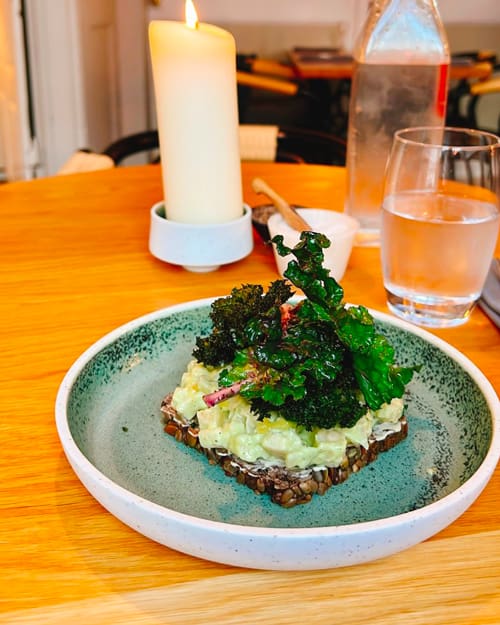
At Torvehallerne you can try the smørrebrød: the typical open Danish sandwiches with rye bread and everything imaginable on top
Day 3 — Canals and industrial archaeology
The third day is the one that in my opinion best tells the story of Copenhagen, and it’s all built around a single idea: here the ugly things aren’t hidden, they’re reopened to the public.
Morning: the canal boat tour
If I had to point to the one paid activity I really recommend in Copenhagen, it’s this one, and it’s also the best way to start the day, given that everything you’ll see today revolves around the harbour.
We chose the guided canal tour on an electric boat, which leaves and returns from Islands Brygge 10. And a reminder, as always, that you get a discount on ANY Get Your Guide activity with the code ANGELAISAI5.
The electric boat is no small detail: you glide along in silence, without the engine noise drowning out the guide’s voice and without the smell of diesel. In a city that has made sustainability an obsession, it’s also the experience most in keeping with the place you’re in.
A curiosity about the departure point: Islands Brygge isn’t just any quay. Here, in 2002, the city’s first harbour public bath opened.
Christianshavn, the little Amsterdam
From Islands Brygge you head north up to Christianshavn, the district of canals. It didn’t come about by chance: it was created by King Christian IV in 1617, who brought in Dutch engineers to build an artificial island copied from the canal cities of Holland.
The two streets flanking the main canal are called Overgaden Oven Vandet and Overgaden Neden Vandet, which literally mean “the street above the water” and “the street below the water”. Here you’ll find the colourful houses and wooden boats exactly like in Nyhavn, but without the crowds.
Two minutes away is Vor Frelsers Kirke, recognisable by its golden spiral spire that twists upwards with an external staircase you can climb. Even just from outside it’s one of the most distinctive buildings in the city. If you want to go up, access to the tower is paid.
Christiania
Christiania is the “freetown” born in 1971, when a group of hippies occupied an abandoned former military area and founded a self-governing community there. After years of negotiations with the Danish government, today it’s officially an autonomous community with around a thousand inhabitants, its own rules, its own nursery, its own shops and bars. No cars come in and every building is covered in murals.
For decades the most famous and most problematic spot in Christiania was Pusher Street, the street where cannabis was sold in broad daylight: photography was forbidden, and over the years control by criminal gangs had led to shootings and deaths. I’d been there when it was still open and in fact I didn’t have many photos. In April 2024 it was the residents themselves, together with the Danish authorities, who physically dismantled it. Today Christiania can be visited freely and peacefully: the ban on photographing people remains, which is a matter of respect towards those who live there, but I found lots of children and families finally strolling around without a care. Really lovely to see — in my opinion it’s worth it!
Boat tour
Vor Frelsers Kirke seen from Christiania
Christiania
Afternoon and evening: Refshaleøen
From Christianshavn you carry on towards Refshaleøen, the island that closes the day. It was one of the largest shipyards in Denmark and today it’s the place where the people of Copenhagen go to eat, drink and swim. You get there by bike in a quarter of an hour, on the 2A bus or on the harbour ferry, which costs the same as a normal transport ticket but effectively gives you a mini harbour cruise.
Worth seeing is La Banchina, a tiny bar on the jetty with a sauna and the basin where you dive straight in off the pier. Be warned it’s really minuscule and fills up early, so get there in good time.
For dinner you go to Reffen, the street food market built inside the old shipyard containers: dozens of stalls with kitchens from all over the world, bars and a brewery, all looking out over the harbour. It’s one of the places where you eat best while spending little in the whole city, and it’s also the spot that most amazed my Instagram followers, because it almost never appears in the classic guides.
In summer the sunset here arrives around nine in the evening with the skyline in front of you, and it’s the most beautiful moment of the day. Crucial note:Reffen is only open from April to October. If you come in winter, this part of the day needs replacing with dinner in the city.
A flag, not an experience: right next to Refshaleøen there’s CopenHill, which perfectly sums up the point of this day — it’s a waste incinerator with a real ski slope on the roof, a climbing wall on the façade and a public path leading to the top. We didn’t go up, so I can’t tell you about it first-hand, but if you have time it’s a few minutes away and the walk up is free. Check the opening times on the website first.
Reffen
Reffen street food
La banchina
What to pack for Copenhagen (the things that saved us)
Power bank — between Google Maps and photos, the battery drains fast. (Click the photo to see the one I use) *affiliate link
If you go in winter: thermal base layers, because here you FREEZE. A must if you feel the cold a bit! Click the photo to buy the ones I use on Amazon. *affiliate link
👜 A comfortable, lightweight crossbody bag. (Click the photo to see the details of my beloved Kipling)
Where to have breakfast: the bakeries of Copenhagen
If there’s one thing that makes Copenhagen worth coming to even just for a weekend, it’s the cardamom buns. I’ll tell you one thing straight away: it’s hard to find bad ones in this city, so don’t get obsessed with the perfect ranking. That said, here are my thoughts after tasting them.
Hart Bageri — The best cardamom croissant of the whole trip, and for me the absolutely unmissable pastry in Copenhagen. If you have to choose just one, choose this. Obviously it’s not the classic cardamom bun but it’s wonderful all the same!
Juno the Bakery — It’s the name doing the rounds everywhere on social media and there’s always an endless queue. Honestly? I think that queue is down more to the power of social media than to substance: I found their cardamom buns average. Personal opinion, of course, but if you’re short on time I wouldn’t queue for an hour for these.
Andersen & Maillard — Special mention, and I particularly recommend the Nordhavn branch: there’s a huge choice and every pastry looks like a work of art. Their cinnamon roll was exceptional.
Sankt Peders Bageri — This one I didn’t manage to try because it was closed for the holidays, so I can’t give you my own opinion. I’m flagging it anyway because it’s the oldest bakery in the city and many people point to it as the absolute best: if you find it open, let me know.
Where to eat without spending a fortune
Copenhagen is expensive and the restaurants very much so, so two practical tips. The first is the street food markets like Broens Gadekøkken, Reffen and Torvehallerne: you eat well at half the price of a restaurant and often with a better view.
The second is Joe & The Juice, which you’ll find practically everywhere in the city: sandwiches, big salads and juices at a humane price. And it’s not the usual international fallback chain: it was born right here, in Copenhagen, in 2002, and only afterwards expanded across the rest of the world.
The smørrebrød, the typical open Danish sandwiches with rye bread and everything on top (herring, salmon, prawns, egg), are worth trying at least once. But there’s no need to book a restaurant specially: you find them everywhere, including in the covered markets and street food markets, where they cost far less. Honest opinion: I tried them and they didn’t become my favourite dish of the trip.
Hart Bageri and their cardamom croissant, unbeatable for me
Juno the Bakery and the famous cardamom bun (overrated, in my view)
Andersen & Maillard, where I found happiness
Museums and attractions: my honest opinion
Copenhagen is a wonderful city for its atmosphere and its districts, but when it comes to museums, in my opinion, it doesn’t offer a great deal. Since I visited them, I’ll tell you how it went.
Ny Carlsberg Glyptotek — the only one I really recommend. Founded in 1888 by Carl Jacobsen, the Carlsberg beer industrialist, it gathers Egyptian, Greek, Etruscan and Roman works. But the reason it’s worth seeing is the building: a winter garden with palm trees and a fountain at the centre of the museum, a little green oasis full of sculptures. Paid entry, with a reduced rate for under-27s. I loved it.
Tivoli, for me a maybe. Open since 1843, it’s one of the most visited theme parks in the world and has seasonal opening, so check the dates before planning it in. The distinctive thing is the deliberately “old-school” rides. I went during the Halloween period (it was free with the Card) and I only found it nice for the decorations. If you go, go in the evening. This time in summer I gave it a miss, also because it isn’t cheap.
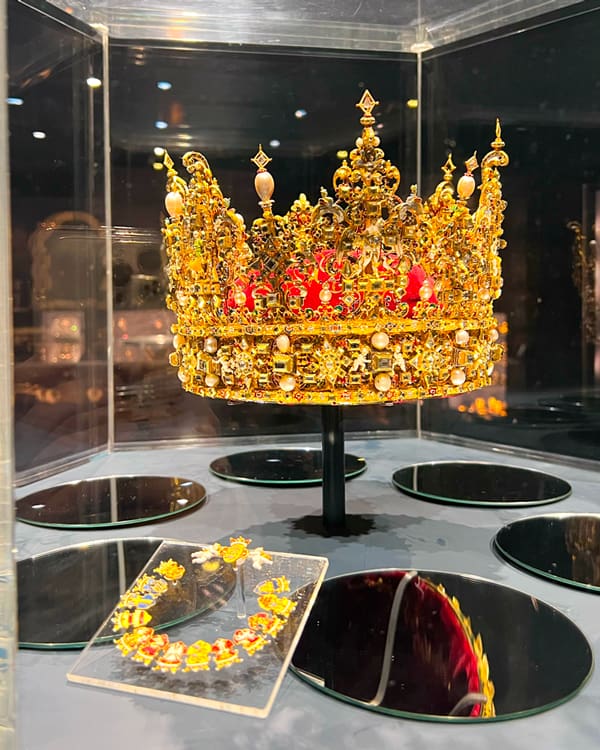
The ones I’d skip. I’m telling you plainly because I saw all three on the same rainy afternoon, and they left me with nothing: Rosenborg Castle, the Natural History Museum and the Botanical Garden. If Rosenborg really does intrigue you, the only part that’s worth it in my view is the crown jewels section in the basement.
Glyptotek
Tivoli when I went in November and it was all decorated for Halloween
The Rosenborg crown jewels, the only part I'd liked
Day trips from Copenhagen
If you have an extra day, the day trip I did is Dyrehaven, the “Deer Park”: you take the train to Klampenborg and in about twenty minutes you’re inside an enormous park, a UNESCO World Heritage Site, which was the hunting reserve of the Danish royal family. Today over two thousand deer roam freely there. I liked it a lot because I love nature and big parks: the best time is deep autumn or spring.
Other good options, in order of distance:
Malmö — in Sweden, just over half an hour by train crossing the bridge over the Øresund. Remember your ID.
Roskilde — half an hour by train, for the Viking Ship Museum and the cathedral.
Helsingør — Kronborg Castle, the one where Shakespeare set Hamlet.
Louisiana Museum of Modern Art — in Humlebæk, on the same line as Helsingør: a modern art museum overlooking the sea, the most famous in Denmark.
Of these I only visited the Deer Park, so the others I’m flagging as ideas to consider, not as my own experiences.
Is Copenhagen worth it?
Yes, and I’m telling you this after being there twice in two opposite seasons and for completely different reasons: the first alone out of curiosity, the second to escape the Italian 39 degrees.
It’s not a city that amazes you with its monuments or its museums, and if that’s what you’re after you’ll be disappointed. What it has that’s special is how it’s organised: a city where you can take endless, totally relaxed walks, where people trust one another, and where there’s an idea of public space that doesn’t exist back home. Factor in that it’s expensive, you spend quite a bit on accommodation and restaurants, but with an apartment, the street food markets and a supermarket shop the bill comes back down.
If you go, let me know: you’ll find me on Instagram by clicking HERE, and on my profile you’ll also find all the videos in the story highlights and the reel-itinerary. 🙂
Three full days is the ideal length: enough to see the old town, the royal quarter, the canals and the less touristy areas without rushing. With two days you see the essentials but you cut out the most interesting part of the city. If you have an extra day, use it for a day trip.
Yes, it’s one of the most expensive capitals in Europe, especially for accommodation and restaurants. You save a lot by sleeping outside the centre, cooking in an apartment and eating at the street food markets, where you spend about half what you would at a restaurant.
It depends how many museums you want to visit. It includes over 80 attractions and unlimited public transport, so it’s worth it if you’re planning several paid entries. If instead you think you’ll spend your days outdoors, it’s cheaper to download the Rejsekort app and pay for individual journeys.
Vesterbro if you want to be near the station and Tivoli, Nørrebro if you’ll accept 10 minutes on the metro in exchange for lower prices, Indre By if budget isn’t a constraint. The city is compact and well connected, so staying outside the centre isn’t a problem.
No, in Denmark they use the Danish krone and euros aren’t accepted. On the plus side you don’t need cash: you pay for everything by card, even a coffee. The exchange rate is fixed at around 7.46 kroner to the euro, so to do quick sums you can divide prices by 7.
Summer if you want the harbour baths, the outdoor markets like Reffen and the very long days, with temperatures around 20-23 degrees. Autumn for the parks and the foliage, bearing in mind though that in November it gets dark as early as the afternoon and many seasonal activities are closed.
It’s consistently near the top of the rankings of the safest cities in the world. I was there alone, often coming back late and in the dark, without ever feeling uneasy. The usual precautions against pickpocketing in tourist areas apply.